
William Shaw (1841–1913)
Founder of Shaw & Sons Ltd.
Introduction
William Shaw (1841–1913) was one of Brisbane’s early retail merchants, establishing what became Shaw & Sons Ltd. From modest beginnings as an ironmonger in South Brisbane, the business expanded into one of the city’s larger department-style stores, occupying prominent premises in Queen Street during Brisbane’s period of rapid growth.
Although Shaw & Sons is now largely forgotten, newspaper reports, government records and surviving photographs show that the business played a small but interesting part in Brisbane’s commercial development during the late nineteenth and early twentieth centuries.
My original interest in William Shaw was simply to confirm my own family history. As the research progressed, however, it became clear that the story extended beyond genealogy. It also provides a glimpse into early Brisbane retailing, immigration, family enterprise and the changing face of the city.
This page is not intended to be a complete academic history. Rather, it brings together official records, newspaper references, family photographs, personal recollections and research notes accumulated over several years. Wherever possible, documented facts have been separated from family memories and informed speculation. Areas that remain uncertain have been noted rather than omitted, in the hope they may assist future researchers interested in Brisbane’s retail history.
Early Life in Ireland
William Shaw was born in Killyleagh, County Down, Ireland (now Northern Ireland), in 1841. He married at age 17 to Mary McCurry and together they raised a large family before emigrating to Queensland in 1883.
The exact reasons for the family’s decision to leave Ireland are unknown. Like many immigrant families of the period, several factors may have influenced the move. Queensland actively encouraged immigration by promoting opportunities for land, employment and business, while political and social unrest in Ireland may also have played a part. Whether William already intended establishing a retail business before leaving Ireland remains unknown.
Approximately half of William and Mary’s children were born in Ireland, with the younger children born after the family settled in Brisbane. Official records confirm at least ten children, although some details surrounding births and family relationships continue to require further research.
We have no ship passenger records for William and Mary. There were many “Shaws” on the remaining or known records.
Building a Business in Brisbane
William Shaw arrived in Brisbane during the early 1880s with his wife Mary and their growing family, after emigrating from Killyleagh, County Down, Ireland. Like many immigrants of the period, he was seeking new opportunities in a rapidly developing colony. Whether his move was motivated by Queensland Government immigration incentives, the political and social conditions in Ireland, business ambitions, or a combination of these factors, is no longer known.
Soon after arriving, William established an ironmongery business in Melbourne Street, South Brisbane, near the Victoria Bridge. An ironmonger in the nineteenth century sold far more than modern hardware stores. Building materials, tools, household goods, agricultural supplies and countless everyday items were commonly found under one roof. As Brisbane expanded, so too did the range of products offered by Shaw & Sons.
Within only a few years the business had grown sufficiently for William to construct larger premises further along Melbourne Street. However, disaster struck during the Great Flood of 1893. Contemporary newspaper reports record that floodwaters reached approximately nineteen feet (almost six metres) inside the building, destroying virtually the entire stock. Like many Brisbane businesses of the time, Shaw & Sons had to begin again.
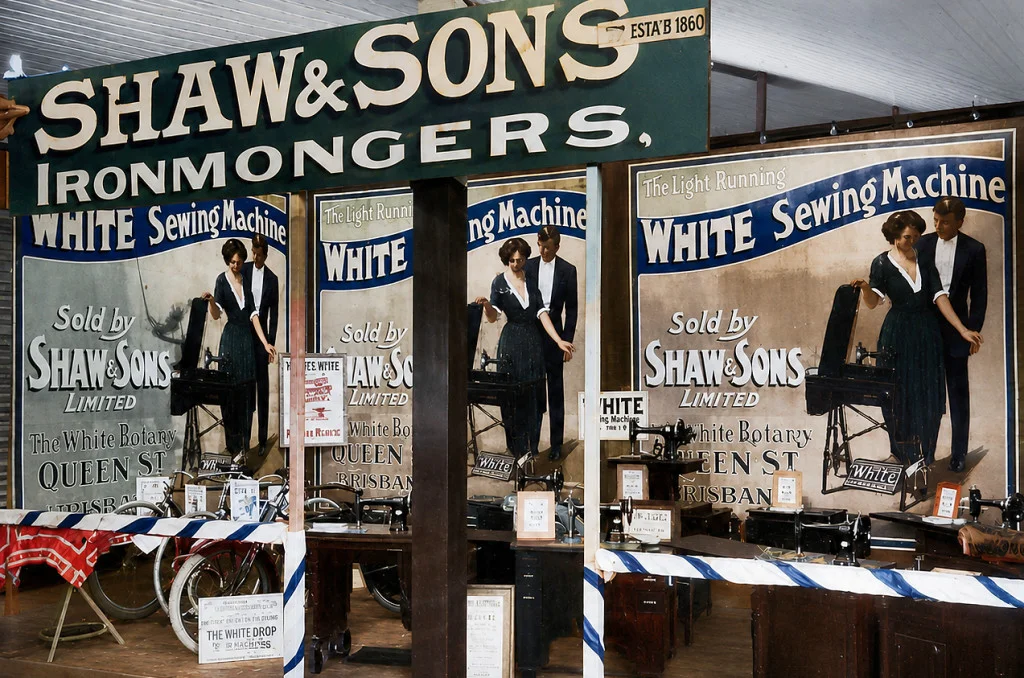
Rather than signalling the end of the business, the flood marked the beginning of a new phase. William relocated into Brisbane’s commercial centre in Queen Street, initially occupying premises later associated with Allan & Stark before moving to premises beside the Town Hall. As the business continued to expand, Shaw & Sons established itself in the Royal Arcade before occupying the newly constructed Granite Buildings from 1904, retaining space in both locations for a period.
The Royal Arcade building was known under different names such as the Exhibition Arcade, the Royal Arcade, the Old Arcade’, and the Red
Arcade in directories until 1899. During this time, proprietors sold goods with a mix of general, fancy goods and hardware, before being taken over by
the well-known ironmongers Shaw & Sons in the mid-1890s.
[ Reference: https://minerva-access.unimelb.edu.au/server/api/core/bitstreams/393f9e4b-c1c7-4efe-8a96-0e8aa9fe74b6/content ]
By the early twentieth century, Shaw & Sons had evolved into one of Brisbane’s larger retail businesses. Rather than being simply an ironmonger’s shop, it had become a department-style store supplying an extraordinary range of goods. Contemporary newspaper advertisements describe builders’ ironmongery, glassware, china, jewellery, cutlery, sporting goods, toys, leather goods, horticultural supplies, household furnishings, haberdashery and many other products.
Christmas advertisements in particular reveal a bustling store designed to appeal to families shopping for everything from practical household necessities to gifts and sporting equipment. In modern terms, Shaw & Sons had become a department store, serving tradespeople and families alike. These Christmas advertisements reveal the importance of the business within Brisbane’s retail life. Window displays, gift ideas and sporting equipment featured prominently, while the company’s extensive stock was promoted as offering “everything” required for the festive season. These advertisements also provide valuable insight into everyday life in Brisbane around the turn of the twentieth century.
The continual relocation and expansion of the business also reflects the rapid transformation of Brisbane itself. During William’s lifetime the city experienced repeated redevelopment, major building projects, devastating floods and changing commercial precincts. Queen Street became the centre of retail activity, with new arcades, banks, department stores and substantial commercial buildings replacing many earlier structures. Shaw & Sons grew alongside that transformation.
As the city continued to develop, the Queen Street premises evolved. Historical newspaper reports show alterations to the Granite Buildings, expansion of display areas and the consolidation of departments under one roof. During the 1920s part of the Granite Buildings was acquired for occupation by the Commonwealth Bank, requiring Shaw & Sons to reorganise its retail space. Large clearance sales accompanied these changes as stock was relocated within the remaining premises.
Today, very little remains of the buildings that William occupied. The Royal Arcade has disappeared, the Granite Buildings have long since been demolished, and much of the surrounding streetscape has changed beyond recognition. Fortunately, newspaper reports, photographs and official records allow part of the story to be reconstructed, preserving the contribution that William Shaw and his family made to Brisbane’s early retail history.
The Granite Buildings themselves have disappeared as Brisbane’s commercial centre has been progressively redeveloped. The site now forms part of the Queen Street and Edward Street precinct surrounding MacArthur Chambers and neighbouring commercial buildings. Although little physical evidence of Shaw & Sons remains, the location continues to be recognised as one of Brisbane’s historic retail precincts, where many of the city’s best-known businesses once traded.
Although the original Shaw & Sons buildings have disappeared, visitors can still stand within the same historic retail district where William Shaw’s business traded for many decades.
William Shaw passed away in 1913, but Shaw & Sons continued to operate under family management for many years afterwards. Newspaper advertisements confirm that the business remained active throughout the 1920s, with various members of the Shaw family continuing their involvement.
Exactly how ownership evolved following William’s death remains unclear. Records indicate that several sons, including Henry and William, were involved in management, while George had already begun developing his own specialist firearms and sporting goods business. Further research into company records would be required to fully document these later years.
At some stage during the early 1930s the Shaw & Sons business came to an end. Family recollections, supported by newspaper references, indicate that Woolworths purchased the remaining stock before establishing its own operations in Brisbane. While the original newspaper reference describing this transaction has unfortunately been lost, it appears that increasing competition from larger retailers and changing commercial conditions made continuation of the family business increasingly difficult.
Although Shaw & Sons disappeared from Brisbane’s streetscape, its contribution to the city’s retail history spanned approximately half a century. Beginning as a small South Brisbane ironmongery and growing into one of Queen Street’s substantial department-style stores, the business reflected the remarkable transformation of Brisbane from a colonial town into a modern capital city.
Family Homes and Daily Life
Compared with the history of Shaw & Sons, relatively little is known about William Shaw’s family homes. As with many nineteenth-century families, official records tend to document business activities more readily than everyday domestic life.
When William first arrived in Brisbane, the family lived in South Brisbane, close to the original Melbourne Street business. Living near one’s workplace was common at the time, allowing both family members and employees to contribute to the operation of the shop.
Later in life William moved to Clayfield, naming his residence “Shrigley” in Armagh Street. The choice of name appears to reflect his continuing connection with County Down, Ireland, where Shrigley is a locality near Killyleagh. Although the exact reasons for selecting the name are unknown, it suggests that William retained strong ties to his birthplace throughout his life.
William died at Shrigley on 22 February 1913 at the age of seventy-one. Newspaper reports describe him as having overcome considerable hardship following the devastating 1893 flood, rebuilding both his business and reputation through determination and perseverance.
William, his wife Mary and their eldest son Thomas are buried together in South Brisbane Cemetery (now Dutton Park Cemetery). Their memorial remains an important physical link to one of Brisbane’s early retail families.
While much about William’s personal life has been lost with time, surviving records suggest a man devoted to both family and business. Together, William and Mary raised a large family whose descendants continued contributing to Brisbane through retailing, sport, military service and community life over several generations.
Exploring William Shaw’s Brisbane Today
Although none of the Shaw & Sons buildings survive, many locations associated with William Shaw can still be visited. Queen Street remains Brisbane’s principal shopping street, while MacArthur Chambers stands only a short walk from where Shaw & Sons traded during its later years. The nearby Treasury precinct, City Hall, the General Post Office, and several surviving nineteenth-century commercial buildings help convey something of the Brisbane that William would have known. William, his wife Mary and their eldest son Thomas are buried in Dutton Park Cemetery, where their headstone remains an important link to one of Brisbane’s early retail families.
By the early 1930s, the corner of Queen and Edward Streets was completely redeveloped for the new AMP Building (now MacArthur Chambers), which opened in 1934. During World War II it became General Douglas MacArthur’s headquarters and today houses the MacArthur Museum.
Then & Now
Melbourne Street Ironmongery | South Brisbane near Victoria Bridge
Queen Street Store | Queen Street Mall precinct
Royal Arcade | Demolished
Granite Buildings | Redeveloped commercial precinct
Commonwealth Bank alterations | Modern commercial redevelopment
MacArthur Chambers | Heritage building open to visitors
Dutton Park Cemetery | William and Mary’s graves still exist
(Other notes we have indicate the first store in Melbourne street, South Brisbane, and over 2 years near Manning Street, with the flood in 1893. Then reopening in the city.)
Opportunities for Further Research
Although many aspects of William Shaw’s life and the history of Shaw & Sons Ltd. can now be reconstructed from official records, newspaper reports and family documents, there are still many areas that deserve further investigation. It is hoped that this material may assist future family historians, students and researchers with an interest in Brisbane’s commercial and retail history.
Areas that may warrant further research include:
- The exact locations, lease arrangements and ownership history of each Shaw & Sons premises in Melbourne Street and Queen Street.
- The development of the Royal Arcade and Granite Buildings, and the changing occupancy of those buildings during the late nineteenth and early twentieth centuries.
- Original company records, business correspondence, catalogues and surviving photographs that may remain in public or private collections.
- Brisbane City Council rate books, building records and survey plans relating to the Shaw family properties.
- Queensland Titles Office records documenting property ownership, leases and commercial transactions.
- Post Office Directories, Pugh’s Almanacs, Wise’s Directories and Sands Directories, which may provide year-by-year evidence of business locations, occupations and household residences.
- Additional newspaper reports, advertisements and photographs held by the National Library of Australia’s Trove collection.
- Business records, maps, architectural plans, photographs and manuscripts held by the John Oxley Library at the State Library of Queensland, together with related collections within the Brisbane History Group and Brisbane City Archives.
- The later management of Shaw & Sons following William Shaw’s death in 1913, including the eventual closure of the business and the transition to later occupants of the Queen Street premises.
Family history often begins with names and dates but gradually becomes the story of a community. During this research it became apparent that the history of Shaw & Sons Ltd. extends beyond one family and forms part of Brisbane’s commercial development during a period of remarkable growth. If this page encourages others to preserve photographs, documents, memories or business records relating to Brisbane’s early retailers, then it will have achieved far more than simply recording one family’s history.
Research References and Search Suggestions
The following resources proved particularly valuable during the preparation of this page. Some are direct references used during this research, while others are suggested starting points for readers wishing to investigate Brisbane’s retail history in greater depth.
National Library of Australia – Trove
The National Library of Australia’s Trove database is the single most important source for researching Shaw & Sons Ltd., William Shaw and early Brisbane retail history.
Useful search terms include:
- “William Shaw” Brisbane
- “Shaw & Sons” Brisbane
- “Shaw and Sons”
- “Shaw & Sons Queen Street”
- “Shaw & Sons Granite Buildings”
- “Granite Buildings Queen Street”
- “Royal Arcade Brisbane”
- “Melbourne Street South Brisbane ironmonger”
- “William Shaw obituary”
- “Mary Shaw Brisbane”
- “Queen Street Brisbane advertisements”
- “Christmas advertisements Queen Street Brisbane”
- “Commonwealth Bank Queen Street Brisbane”
- “Woolworths Brisbane Queen Street”
- “George Shaw Brisbane”
- “George Shaw rifle shooting”
- “George Shaw sports store”
Searching by individual years (for example, 1893, 1904, 1913, 1924 and 1929) can often reveal additional advertisements and newspaper reports.
State Library of Queensland
The John Oxley Library holds one of Queensland’s largest collections relating to Brisbane’s history. Particularly useful resources include:
- Photographic collections
- Architectural drawings
- Business records
- Family papers
- Maps and plans
- Queensland Post Office Directories
- Pugh’s Almanacs
- Wise’s Directories
These collections may contain additional references to Shaw & Sons Ltd., neighbouring businesses and the changing Queen Street retail precinct.
Brisbane City Archives
Potential research sources include:
- Rate books
- Building applications
- Sewerage plans
- Fire insurance maps
- City plans
- Commercial property records
These records may assist in identifying the precise locations occupied by Shaw & Sons over time.
Queensland Titles Office
Further research may establish:
- Property ownership
- Lease arrangements
- Transfers of title
- Commercial tenancy records
This work has not yet been undertaken and may provide opportunities for future historical research.
Other Suggested Research Topics
Readers interested in Brisbane’s retail development may also wish to research:
- Allan & Stark
- McDonnell & East
- Finney Isles
- Brisbane Arcade
- Royal Arcade
- Granite Buildings
- Queen Street retail history
- MacArthur Chambers
- Brisbane department stores
- 1893 Brisbane Flood
- Early Brisbane shopping arcades
Together these subjects provide valuable context for understanding the environment in which William Shaw established and developed Shaw & Sons Ltd.